The sun is beneficial for the body, but it can easily turn into an “enemy” if we do not follow a few important rules. Here are 4 tips from Dr. Ion Florea, dermatologist, doctor of medicine, about sun exposure and skin cancer prevention.
Is the sun our friend or enemy?
Life is impossible without the sun, so the sun is more than our friend. But, as a general rule, the dose matters, because melanoma is one of the most aggressive forms of cancer. Untimely and long-term sun exposure is very dangerous. Going to the beach and starting by staying in the sun for a few hours daily to get a tan at home is risky.
Sun exposure is done slowly and progressively, prolonged exposure is avoided. And even in the case of slow exposure, a cream with a high protection factor, 50 or even 90 -100 in the case of people with light skin or with dysplastic nevi (many moles) is mandatory. A cream with a protection factor of 100 protects you for about 4 hours after which it is no longer effective. In summary, the sun is beneficial and healthy, but use sun exposure carefully.
Should people with many moles or lighter skin be more careful when exposed to the sun?
These people should definitely benefit from increased protection from ultraviolet rays.
People with lighter skin have a lower number of melanocytes (cells that give skin color) and those with darker skin have a higher number of melanocytes and are thus slightly more protected from ultraviolet rays.
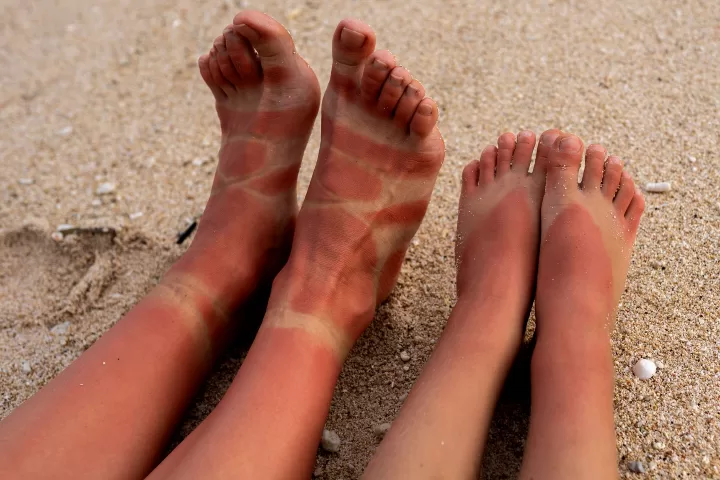
Basically, when you tan, melanocytes produce more and more melanin to protect themselves from the sun's rays and thus the skin darkens. If you do not give the body time to produce melanin through gradual exposure, burns appear on the skin. Moreover, there is also a cellular memory and repeated burns lead to cellular changes and over time the cells can turn into malignant (cancerous) cells.
Therefore, sun exposure is done gradually, to give the body time to manufacture melanin that will protect us from UV rays.
Dysplastic nevi (moles on the skin that are not raised) are genetically transmitted, and people who have these nevi must avoid long-term sun exposure, but they can stay a little today, a little tomorrow, they do not have a major contraindication. However, they must always use creams with a protection factor of 90 -100.
Equally important is the fact that these moles are not subjected to multiple, repeated small traumas. For example, if the moles are in an area of friction (at the waist at the belt of the pants, in the area of friction of underwear, shoes) they must be excised completely. Excision is very easy, but it is important to excise them completely, you can't just remove part of the mole.
What are the symptoms that should lead us to a dermatologist? Is it possible that, identified in its early stages, skin cancer may not need radiotherapy and chemotherapy?
When a dysplastic nevus begins to grow, changes its color, appearance, or symmetry, it is good to consult a dermatologist. Dermatology has the great advantage that the disease is visible and people usually come to the doctor. This means that many melanomas are identified in their early stages, in situ, and for this stage no aggressive treatment is done, neither chemotherapy nor radiotherapy, but only surgical excision.
If changes of the type mentioned are observed, a dermatologist should be consulted immediately. The decision should not be postponed, because as I said, melanoma is very easily treated if identified in its initial stages.
And the patient must be encouraged regardless of the stage at which the disease is detected, you should not just tell him "you have melanoma", because you scare him and it is not good to do tests after tests and be guided by the financial side.
But even so, melanoma has come to be mastered, it is an incredible step for medicine, patients who live with advanced stages of melanoma, which did not happen just a few years ago. The Romanian state is making an extraordinary effort: in Romania there are state-of-the-art drugs, sometimes there is no difference between the treatment of melanoma in Botoșani or Los Angeles. And it is very good that oncological medicine has developed and keeps up with new treatments. It does not even compare to the treatment of 40 years ago. Tens of thousands of patients have passed through my hands and there is no comparison between the treatments now and the treatments since I started practicing. In metastases there are immunotherapies that I consider incredible, and patients should not be discouraged, technology and research have come a long way.
Can skin cancer be prevented? What would be your recommendations for prevention?
The sun is the main cause of this type of cancer and aggravating factors are light skin, dysplastic nevi and especially prolonged and constant exposure to the sun regardless of skin type. As a prevention, I would mention four factors:
- Clothing offers very good protection. As you well know, in areas with excessive sun, instinctively for thousands of years, people have protected themselves by clothing that covers their entire body (the Bedouins in the desert, etc.). If during the summer we are in an area with strong sun, it is good to wear clothes that cover our entire body;
- Slow and gradual exposure to the sun only in the morning and evening;
- Creams with a protection factor are very new, about 30-40 years old and appeared as a necessity because seaside holidays have become increasingly accessible and popular;
- Extirpation of moles that are in a friction area.
Article taken from the publication „Notar de București”