What is fever?
Fever (a temperature over 37.5 degrees Celsius) is common in children. Fever is a normal response to many illnesses, the most common being an infection in the body. Fever itself is usually not harmful – in fact, it helps the body's immune system fight infection.
While your child's fever may be of concern to you, doctors will usually be more concerned with what is causing the fever rather than the child's temperature itself. It is therefore more important to monitor the accompanying symptoms than the fever itself. On the Digital Clinics platform, you can request the help of a paediatric specialist, without having to travel with your child to a doctor's office.
How to measure temperature correctly?
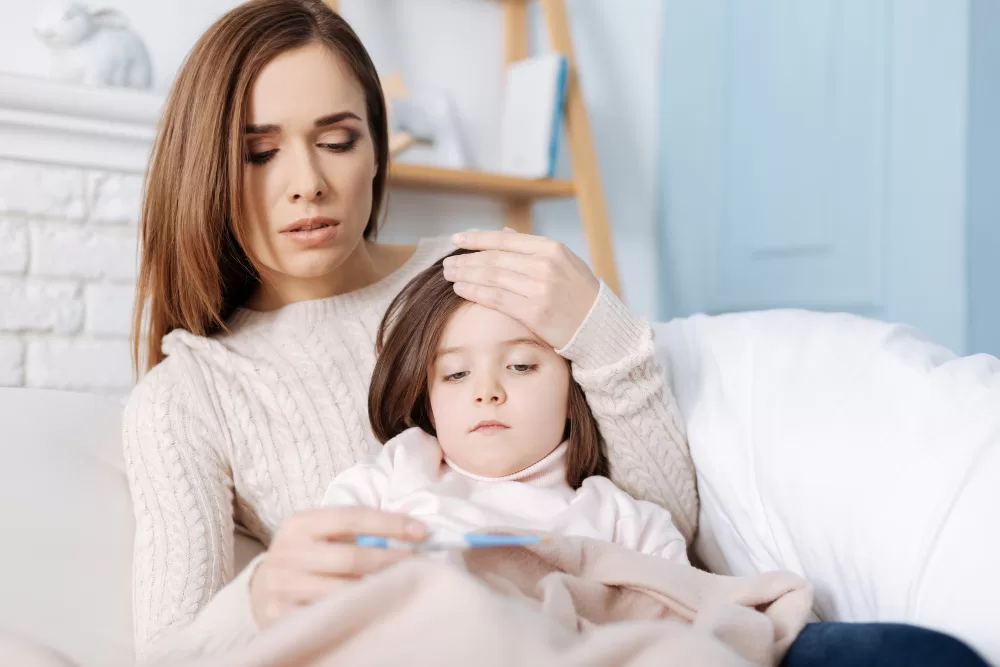
To know if your child has a fever, you will need to take their temperature. There is a wide variety of thermometers available, from standard oral thermometers to sophisticated temporal artery scanners.
The simplest and most accurate is the classic thermometer, used
rectally for infants and small children, and for older children, used orally.
What is considered a fever?
A "normal" body temperature is 37 degrees Celsius, but
that doesn't mean you need to hit the panic button if your child's temperature
is above this. Everyone's temperature will vary slightly throughout the day. It
can also vary based on age, activity level and other factors.
The type of thermometer you use can also change the definition of what is actually a fever for your child. Different types of thermometers have different levels of accuracy. This fever chart can help you understand the results you're seeing.
Child's fever chart
Age of the child |
The best type of thermometer |
What is considered a fever |
0 to 2 years |
Rectal |
38 C |
0 to 2 years |
Armpit |
37,2 C |
2 to 5 years |
Rectal |
38 C |
2 to 5 years |
Ear |
38 C |
2 to 5 years |
Armpit |
37,2 C |
Over 5 years |
Ear |
38 C |
5+ years |
Oral |
37,7 C |
5+ years |
Armpit |
37,2 C |
When the child has a fever, he may also:
• Be hot to the touch
• Be very easily irritable or cry more than usual
• To be more sleepy than usual
• Vomiting or refusing to drink fluids
• To tremble, to have chills
• To have pain
• If your baby is under three months old and has a fever of over 38°C, then you should see a doctor, even if they have no other symptoms.
Can fever cause seizures?
Febrile seizures can be a very scary side effect of fever in some children. Febrile seizures occur in 2% to 4% of children under 5 years of age. Not all seizures cause obvious body movements, sometimes seizures look more like a “fainting.
If the child has febrile convulsions:
• Put the baby on its side.
• DO NOT put anything in the child's mouth.
• Call an ambulance if the seizure lasts more than five minutes.
• If the seizure lasts less than five minutes, contact your family doctor or pediatrician.
How to take care of your child with fever at home
Infections that cause fever can be caused by different types of
germs. Most are caused by viruses and do not require treatment. Some are caused
by bacteria, which are treated with antibiotics. Antibiotics do not work on
viruses.
Lowering your child's fever will not help treat the underlying disease faster.
If the child is in a good general condition, there is no need to treat the fever. If your child is visibly unwell, there are things you can do to help them feel more comfortable:
• Give your child drinks in small, frequent mouthfuls. Many children refuse to eat when they have a fever. This is not a problem as long as they stay hydrated.
• If your breastfed baby is under six months old, provide additional feedings
• If the formula-fed baby is less than six months old, give him the usual amount of milk
• If your baby is more than six months old, continue to breastfeed him the same way. In addition, you can give him water or oral rehydration solutions.
• Give your child paracetamol and/or ibuprofen if the fever worsens or if he has other symptoms such as a sore throat. Always follow the dosage instructions on the package carefully. Do not give ibuprofen to children under three months of age or to any child who is dehydrated. Never give aspirin to children. And most importantly, do not give medicine to the child before consulting with a pediatrician.
• You can wipe his forehead with a wet towel. It is important that it is not too cold. Cold baths or showers are not recommended.
• The child must wear enough clothes so that he is not too hot or too cold. If the baby is shivering, add another layer of clothing or a blanket until it stops.
• Watch for any other symptoms and keep in touch with your paediatrician.
When should you go to the doctor?
Consult a pediatrician when your child has, in addition to a fever, the following symptoms:
• a stiff neck
• a rash that doesn't go away when you press on it
• the child is disturbed by light
• the child has a seizure (febrile convulsions) for the first time
• the child has unusually cold hands and feet
• the child has blue, pale or spotted skin, lips or tongue
• the baby has a low, high-pitched cry that is not like his normal cry
• the child is sleepy and difficult to wake up
• the child is extremely agitated (doesn't stop crying) or is confused
• the child finds it difficult to breathe and sucks his abdomen under the ribs when he breathes
• the child is not responding as they normally do or is not interested in feeding or normal activities
What are the causes of fever in children?
Most commonly, fever is caused by infections. High body
temperature makes it more difficult for bacteria and viruses that cause infections to survive.
Conditions that can cause fever are:
• upper
respiratory tract infections
• Flu
• ear
infections (otitis)
• roseola
– a virus that causes a fever and rash
• tonsillitis
• kidney
or urinary tract infections
• common
childhood illnesses such as chicken pox or whooping cough.
The child's temperature can also rise after vaccinations or if he
overheats due to too many clothes or too thick bedding.
Another cause of fever is dental eruptions, but these do not give
a temperature higher than 38 degrees Celsius.
Whatever medical problems your child is facing, on Digital Clinic
you have an experienced paediatrician
just a click away, who is ready to give you the advice and all the support you
and your child need.
Conditions that can cause fever are:
• upper respiratory tract infections
• Flu
• ear infections (otitis)
• roseola – a virus that causes a fever and rash
• tonsillitis
• kidney or urinary tract infections
• common childhood illnesses such as chicken pox or whooping cough.
The child's temperature can also rise after vaccinations or if he overheats due to too many clothes or too thick bedding.